Late last year, the Harvard Business Review detailed some of the hospital design elements that lead to better patient outcomes. From fresh flowers to daylighting techniques to amenities, building materials and more, good hospital design plays an active role in modern patient care.
The most fundamental driver of good design is scientific. The proliferation of microorganisms, both fungal and bacterial lead to 1.7 million hospital acquired infections (HAI) each year with 99,000 deaths (Centers for Disease Control and Prevention). It appears that shared or open design in hospitals is leading to the spread of infection. If so, the move to partitioned, private spaces would defy emerging trends towards openness in commercial architecture. And HBR indeed confirms that switching to private rooms can decrease bacterial infection – two McGill University hospitals saw such infections decrease by over 50% after making the switch.
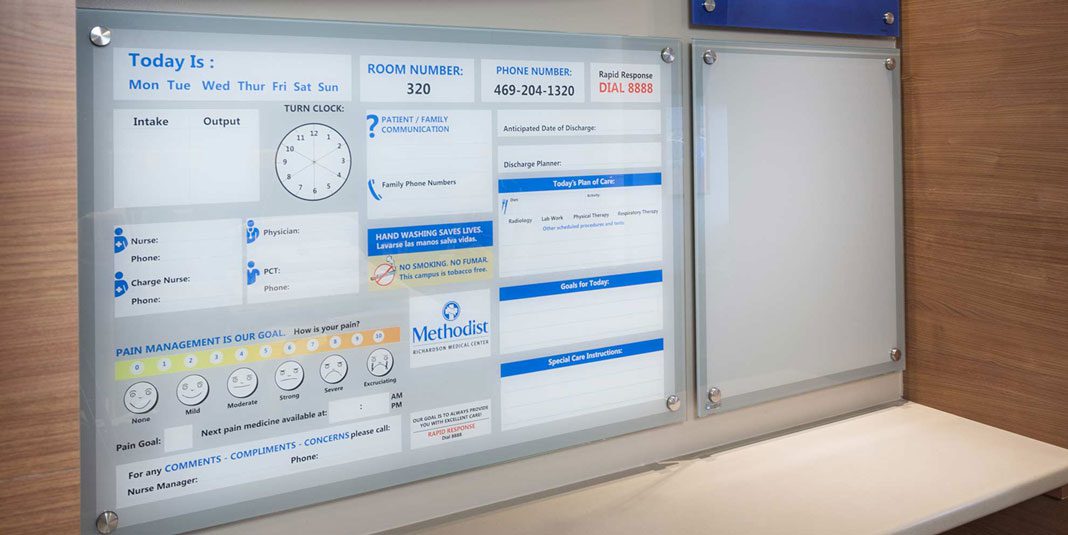
Anti-microbial design also lends itself to the use of non-porous materials, such as glass, over plastic. In the case of writable surfaces, this means that standard whiteboards, must be traded out for Healthboards – as practitioners share writing surfaces, washed hands or not, they become breeding grounds for bacteria. Other design factors, such as ventilation are key factors in preventing the spread of infection.
Good hospital design can also take on a more intangible value, notable in thought leadership such as Roger Ulrich’s 1984 paper titled ‘View Through a Window May Influence Recovery from Surgery’ in which patient outcomes with and without ‘views’ were compared. Clinical data proved that outdoor views shortened hospitals stays. This data is confirmed anecdotally by 95% of people who say that the mere walking through a hospital garden delivers a therapeutic benefit.
The practice of designing with such considerations in mind has been coined ‘Evidence-based Design’ (EBD). According to Becker’s Hospital Review:
In EBD, decisions about the built environments are based on credible research that will, in turn, create the most efficient outcome. Decisions consider the following factors:
- Enhancement of patient safety
- Reduction of medical errors
- Decreased patient need for medication
- Reduction of staff injuries
- Increased staff efficiency through improved workflow
Clarus Healthboards support EBD, in alignment with healthcare practitioners and administrators alike, for the improved patient outcomes it enables. Healthboards were designed for the EBD design imperative. The following Healthboard characteristics make Clarus the superior EBD partner for improved design:
- Glass is not porous, making it the anti-microbial material required for easy cleaning
- Healthboards enjoy superior user-engagement to traditional whiteboards, thus improving adoption, collaboration and workflow
- Through consistent use in hospital rooms, writable surfaces improve patient communication – and HCAHPS scores – by clarifying instructions
- With improved communication, medication is consumed properly, reducing the chance for error and over-consumption
- Healthboards are load-tested to 6500lbs, which means that in bustling healthcare settings and in times of emergency, the board will be as durable as the wall
- Up to 1 million patients fall each year, with up to 50% resulting in injury. Patients reaching for support can trust a Glassboard, with tempered glass and 6500lbs strength. Healthboards are a safety improvement.
- Custom design and branding improve communication and can be tailored to custom workflows, and elevate morale
Glass itself is an important material, increasingly popular for architectural use in and out of healthcare environments. And only glass enables the aforementioned ‘View Through a Window’. But with Clarus Healthboards, glass becomes an active participant in good hospital design. From infection control, to therapeutic benefits, to collaboration tools, the customizable, durable and aesthetically stunning Clarus Healthboards, are the ideal complement for the next generation of effective hospital design helping deliver improved patient care.