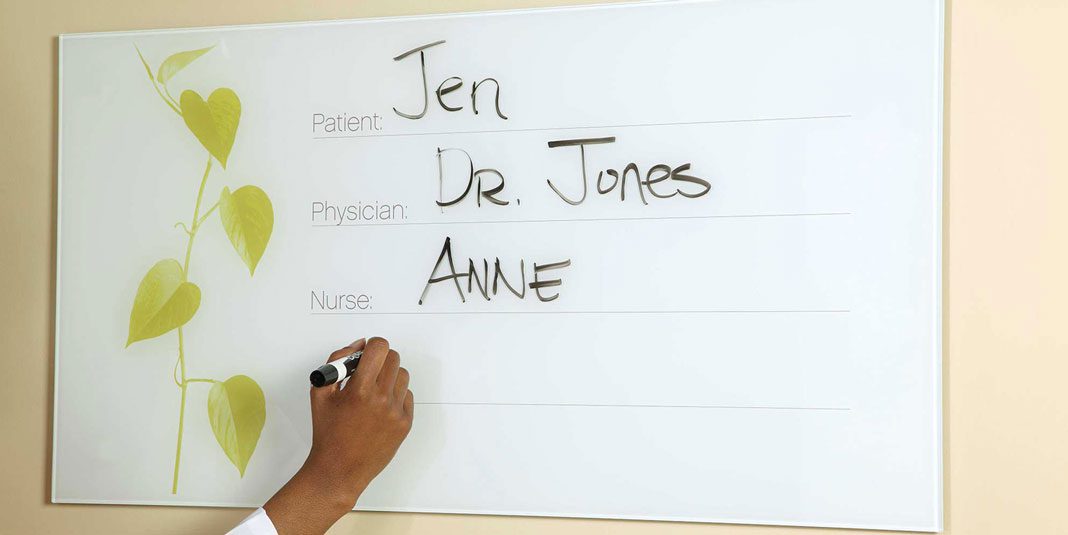
Clarus Healthboards serve the critical mission of improving communication and collaboration in healthcare environments. As the natural evolution to the whiteboards of old, Healthboards are built of indestructible, anti-microbial glass, with 6500lbs tested adhesive mounts. But perhaps most important among their differentiators is the communication they enable, through a colorful, electrifying, writing surface and any one of millions of combinations of inserted or printed template combinations tailored to hospital operational needs.
Simply put, Healthboards are built to improve communication in healthcare environments. And data consistently proves that poor healthcare communication in the absence of best practices and tools is a leading cause of malpractice suits and operational inefficiency in hospitals.
Harvard Medical Institutions’ Risk Management Foundation produced an annual report on Malpractice Risks in Communication Failures. This ‘Benchmarking Report’ serves to assist in optimizing patient care by identifying industry-wide opportunities for improvement, based on research and 23,000 medical malpractice claims.
The report focuses on 7,149 instances of failed communication, surveyed from the medical professional liability experience of 165,000 physicians. These cases resulted in $1.7 Billion in losses – an average of $237,795 per incident.
It defines communications errors in healthcare settings as follows:
- Face-to-face conversations
- Electronic exchanges
- Clinical notation and interpretation
- Breakdowns in timing, accuracy and legibility
- Systems failures
- Instructions among providers, patients, and family members
And of the breakdowns in communications, the following issues were most common:
- Miscommunication regarding the patient’s condition
- Inadequate informed consent
- Poor documentation
- Unsympathetic response to patient complaint
- Failure to read the medical record
- Inadequate education regarding medications
- Incomplete follow-up instructions
- No or wrong results given to patient
- Miscommunication due to language barrier
In addition to the $237,795 per incident, such inefficiencies lead to $4 million in losses each year for the average 500 bed hospital, a maximum of $8000 per room—enough in variable costs to justify improved fixed investment in communication. And if outfitting each room with a Healthboard could offset some of the $4 million loss, one could do so—serving 500+ rooms—with over $3.5 million to spare.
Healthboards are the optimal solution for improving communication because of their specific impact on a multitude of the breakdowns and factors listed above. For example, Healthboards are the perfect tool to communicate medication instructions, follow-up instructions, demonstrate sympathy and support, illustrate your way around language barriers and more. By adding visual communications, doctors and nurses dramatically improve their communication outcomes.
And patients are waiting for it: 73% say they are ‘concerned’ about the potential for medical errors. And communication affects the most sensitive of hospital visits—33% of obstetrics-related malpractice cases involve communication errors.
Ultimately, Harvard’s report advocates for upfront investment of time to improve communication:
Time spent developing the techniques and habits that improve communication during encounters with patients and exchanges with colleagues is considerably less stressful than time spent defending care complicated by communication failures.
The communication malpractice numbers are surprisingly consistent. For example, malpractice in nursing similarly carries a 33% incidence of communication failure. 37% of high-severity injury cases involve a communication failure. And despite the proliferation of digitized patient records, mobile devices and the ubiquity of digital technology in hospitals, communications problems persist.
The solution may be more fundamentally interpersonal, requiring tangible, multi-modal communication. Systems that exist digitally, out of sight or otherwise disconnected from healthcare battlegrounds in patient rooms and staff meeting areas fail to solve for in-person communication. After all, most communication between doctors, nurses and patients takes place ‘face to face’. The use of Clarus Healthboards in hospitals improves such interaction through visually engaging design, and healthcare-tailored features and functionality.
For more information on the effectiveness of Clarus Healthboards, and best practices in communication, visit and bookmark clarus.healthcare.